DeFi and NFTs in USA 2026

Table of Contents

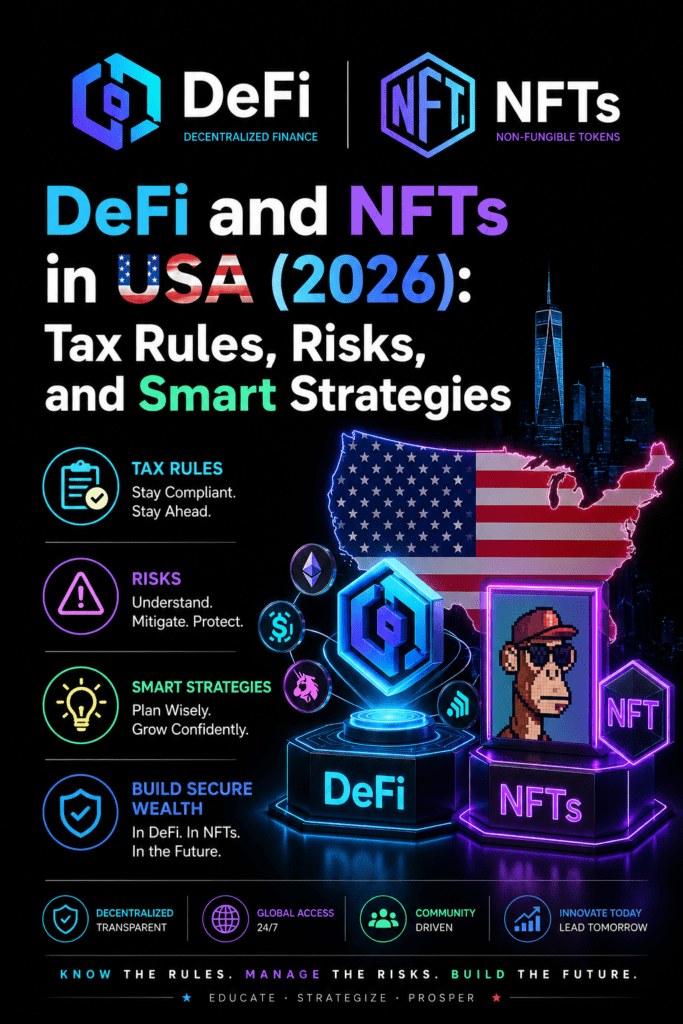
DeFi and NFTs in USA (2026): Tax Rules, Risks, and Smart Strategies

The rise of decentralized finance and digital ownership has transformed the crypto space. Today, DeFi protocols and NFTs are no longer niche—they’re a major part of the global digital economy.

However, with innovation comes complexity.

For U.S. investors, understanding DeFi and NFTs in USA is not just about making profits—it’s about staying compliant with evolving tax rules and avoiding costly mistakes.

In this guide, you’ll learn how DeFi and NFTs work, how they are taxed, and what strategies smart investors are using in 2026.

What Are DeFi and NFTs in USA? (Featured Snippet Section)

DeFi and NFTs in USA refer to blockchain-based financial systems and digital assets that are taxed under rules set by the Internal Revenue Service. These include activities like staking, trading, NFT sales, and yield farming, all of which may trigger taxable events.

 In simple terms:
If you interact with DeFi or NFTs, there’s a high chance it creates a tax obligation

DeFi and NFTs in USA: Quick Overview

FeatureDeFiNFTs
Tax TypeIncome + Capital GainsCapital Gains / Income
ComplexityHighMedium
IRS TrackingIncreasingIncreasing
Common UseYield, lendingArt, gaming

This is why DeFi and NFTs in USA require careful tax planning.

What Are DeFi and NFTs?

DeFi (Decentralized Finance)

DeFi refers to blockchain-based financial systems that operate without banks.

Common activities:

  • Lending and borrowing
  • Yield farming
  • Staking
  • Liquidity pools

NFTs (Non-Fungible Tokens)

NFTs are unique digital assets stored on blockchain networks.

Common use cases:

  • Digital art
  • Gaming assets
  • Membership access
  • Intellectual property

Why DeFi and NFTs in USA Matter

Adoption of DeFi and NFTs in USA is growing rapidly due to:

  • High return potential
  • Passive income opportunities
  • Growth of creator economy
  • Expansion of Web3

 But regulation is also increasing alongside adoption.

How DeFi Is Taxed in the USA

According to Internal Revenue Service guidance, DeFi transactions must be reported at fair market value.

Common DeFi tax treatments:

  • Token swaps → Capital Gains Tax
  • Staking rewards → Income Tax
  • Yield farming → Taxable income
  • Liquidity pools → Gains or losses

 Every transaction must be recorded in USD at the time it occurs.

NFT Taxation in the USA

NFTs follow similar but slightly different tax rules.

NFT taxable events:

  • Selling NFTs → Capital Gains Tax
  • Minting & selling → Business income
  • Royalties → Taxable income

 Some NFTs may even be taxed as collectibles depending on use.

 Hidden Insight: Why DeFi Taxes Surprise Investors

Most investors don’t realize this:

 A single DeFi action can trigger multiple taxable events

Example:

  • Add liquidity → taxable disposal
  • Earn rewards → income
  • Withdraw → capital gain/loss

 This is why DeFi and NFTs in USA taxation is more complex than regular crypto trading.



2026 Trends: Future of DeFi and NFTs in USA

  • Increased IRS tracking
  • More DeFi tax clarity
  • Growth in NFT utility
  • Stronger compliance enforcement

 Regulation will shape the future of DeFi and NFTs in USA.

FAQs

Are DeFi transactions taxable in the USA?

Yes, most DeFi activities are taxable.

Are NFTs taxed in the USA?

Yes, under capital gains or income rules.

Do I need to report staking rewards?

Yes, they are taxable income.

Can I reduce DeFi taxes legally?

Yes, through loss offsetting and tax strategies.

Who regulates crypto taxes in the USA?

The Internal Revenue Service.

Latest Articles

Stay Connected

Inquiry Form
DeFi and NFTs in USA 2026: Tax Rules, Risks & Opportunities

7 Crypto Tax Accountants: Expert Crypto Accounting & Tax Filing Services

Need reliable crypto accounting and tax filing services? Contact 7 Crypto Tax Accountants today by call or email to get expert support.

Conclusion

DeFi and NFTs are reshaping finance—but they come with tax responsibilities.

Understanding DeFi and NFTs in USA helps you:

  • Stay compliant
  • Avoid penalties
  • Maximize profits

 The key:
Plan smart, track everything, and stay compliant

DISCLAIMER

The information presented in this blog is sourced from publicly available and third-party materials. 7 Crypto Tax Accountants does not claim ownership of this content and provides it for general informational purposes only.

7 Crypto Tax Accountants makes no representations or warranties regarding the accuracy, completeness, or reliability of the information. You should not treat this content as financial, legal, or tax advice.

7 Crypto Tax Accountants is not responsible for any decisions, losses, or damages resulting from the use of this information. Until You  consult with 7 Crypto Tax Accountants before taking any action related to crypto taxation or financial matters.